

Band management for indie bands: a practical guide
How to organise an indie band - song versions, feedback, setlists, gigs, money, and sending music to labels - without a manager or a stack of subscriptions.
By @KHeavy
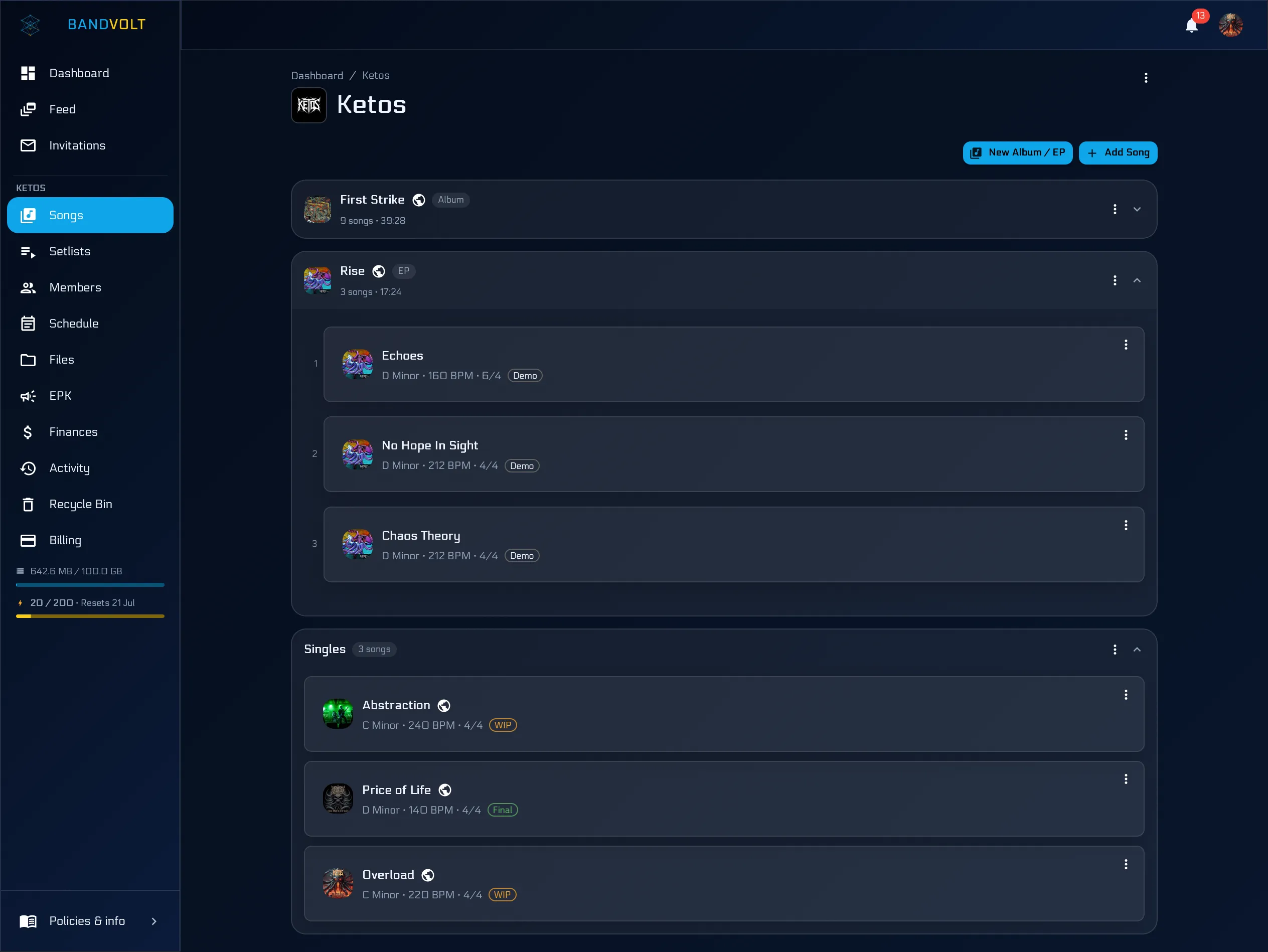
The short answer: an indie band stays organised by keeping six things in one shared place - song versions, feedback, setlists, the gig calendar, files, and money. BandVolt is a band management app built around exactly those six, and the Basic tier is free with no credit card.
Nobody in an indie band signed up to be an administrator. But somebody ends up being one - the person who keeps the Drive folder, chases the deposit for the support slot, and knows which bounce is actually the latest.
This guide is the system that person wishes existed. It works whether you adopt BandVolt or build it out of other tools; BandVolt just puts all of it in one workspace.
1. One home for the songs
Every demo, voice memo, and mix goes to the same place, as a version of the song it belongs to - not as final_final_v3.wav in a chat thread. In BandVolt, each upload is labelled, dated, and listed in chronological order with its own waveform player, and your audio is never compressed.
When the new mix lands, everyone hears the same file. When you need the take from March, it is still there.
2. Feedback on the track, not in the chat
Notes like “the vocal is buried after the second chorus” are useless three days later in a group chat. Pin feedback to the exact second in the track instead. Reply threads keep the argument in one place, and comments get marked resolved when actioned - so the mix engineer works from a punch list, not a scroll-back.
If the thread gets long, BandVolt’s AI Mix Summary distils every unresolved comment into a short list of what actually needs to change.
3. Setlists that match the show
Build the set from your own library, so key, BPM, and length come along automatically. Each setlist can use any version of a song - the recorded cut or the extended live arrangement - and unreleased songs go straight in, which a streaming playlist can never do. When you are running the set in rehearsal, playback mode puts key, BPM, lyrics, and time signature in front of you.
4. A calendar everyone actually checks
Gigs, rehearsals, and studio dates on one shared calendar, visible to every member, with the setlist and the tech rider attached to the event they belong to. “When is practice again?” stops being a weekly question.
5. The money conversation, minus the awkwardness
Indie band finances fail on transparency, not on maths. Log gig fees, merch income, and expenses in a shared ledger with receipts attached, set the rehearsal room rent to recur, and everyone sees the same numbers. Splitting income at the end of the year becomes arithmetic instead of archaeology.
6. Sending music out without friction
When you pitch a label, promoter, or radio show, the last thing you want is to make them create an account. Generate a public link and they stream your song - or your whole EP on Premium - instantly in the browser. Revoke the link whenever you like.
What it costs
BandVolt’s Basic tier is free: 10 workspace slots, song versioning, timestamped comments, setlists, the shared calendar, and band finances included. Premium is £9.99 a month per band with 25 workspace slots - not per person - which for a 5-piece works out at about £2 each. Need more room? Packs of 10 are £2.49/month on Premium.
Start your band’s workspace free - no credit card required.
Topics: band management app · band management software · tools for indie bands