

Running a remote band without losing momentum
When the band lives in three cities, the workflow is the only thing keeping the project moving. A practical guide to remote band collaboration - handoffs, deadlines, decision-making, and the tools that hold it together.
By @KHeavy · Updated 1 August 2026
Bands are increasingly remote. The drummer is in Manchester, the producer is in Berlin, the singer is on tour somewhere. You meet in person twice a year to track. The rest happens in files.
That model only works if the workflow is tight. When it is loose, momentum dies - and the project quietly stalls for months without anyone saying it has.
Distance is not the problem
It is worth naming the real failure, because bands usually blame the wrong thing.
Remote bands do not stall because people are far apart. They stall because nothing is visibly waiting on anyone. In a rehearsal room, the state of a song is obvious - you can hear that the bridge is not working, you can see that nobody has learned the new part. Remotely, all of that is invisible. Everyone assumes progress is happening somewhere else, and four weeks go by.
The three specific ways it dies:
- The unowned handoff. A mix goes out for feedback. Three people give notes, one does not, and the producer waits because they are not sure if the fourth is coming. Nobody is being difficult. There is just no agreed answer to “is this done yet?”
- The lost decision. The band decides something on a Tuesday in a chat thread. Nobody records it. Three weeks later half the band is working from the old decision.
- The dead drop. Somebody uploads a file and says nothing, or says something in a place the relevant person does not read. The work exists and is invisible.
Every remote band fix is really a fix for one of those three.
A shared room for the music
Everyone opens the same workspace and sees the same songs, the same versions, the same comments. There is no “did you get my email” because the conversation lives on the song.
When the drummer uploads a re-take of the snare, the producer in Berlin gets a notification. They open the song. They hear the new version. They leave a comment at 2:14. The singer reads it on the tour bus.
The band is still in three cities. The work is in one place.
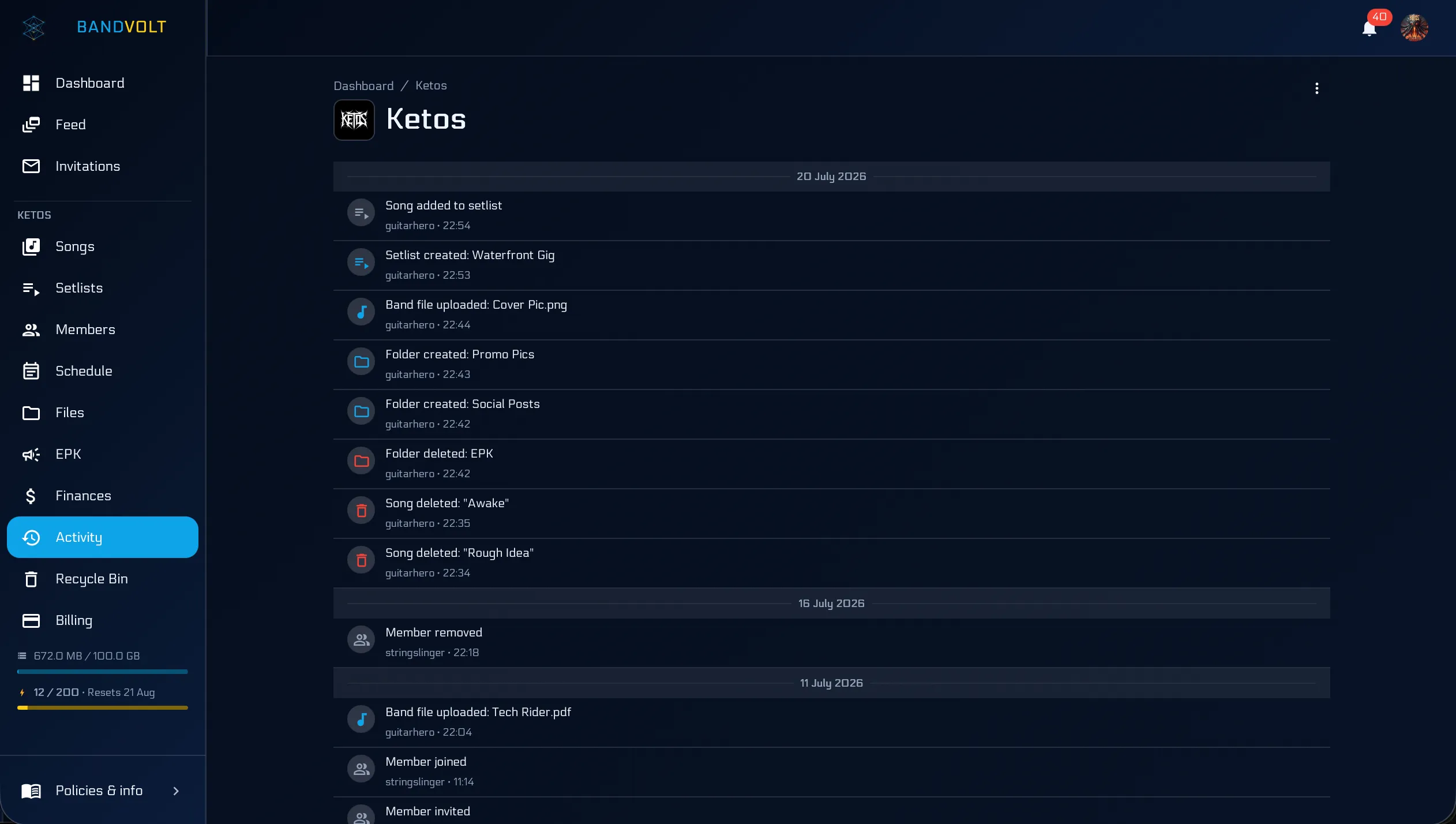
That single change - the conversation living on the song rather than in a chat thread - removes the dead drop entirely. There is no separate act of telling people; uploading the work is telling people.
Make the handoff explicit
The habit that separates remote bands who ship from remote bands who drift is small and slightly unnatural: every time you put work down, say who picks it up and by when.
Not a project management system. One sentence.
“New mix up. Notes by Sunday and I’ll re-bounce Monday night.”
That sentence does three things. It sets a deadline, so waiting has an end. It names the next actor, so nobody is silently waiting on nobody. And it makes lateness visible without anyone having to chase - if it is Monday and there are two sets of notes, the situation is a fact rather than an accusation.
The corollary is worth saying too: agree what “no response” means. In most bands the honest answer is “no notes by the deadline means you are happy with it”. Say that out loud once and an enormous amount of waiting disappears.
Deadlines beat meetings
Remote bands tend to over-correct into scheduled calls, which is usually the wrong instinct. A call is expensive - four people, a fixed time across time zones - and most of what happens in it could have been a comment on a waveform.
What actually needs a call is a decision the band disagrees about. Everything else is better asynchronous, where people can listen properly on their own monitoring instead of through a video call.
So: fewer calls, more dates. Every song that is in progress should have a next date attached to it, and that date should live where everyone can see it rather than in one person’s head.
Shared calendar that means something
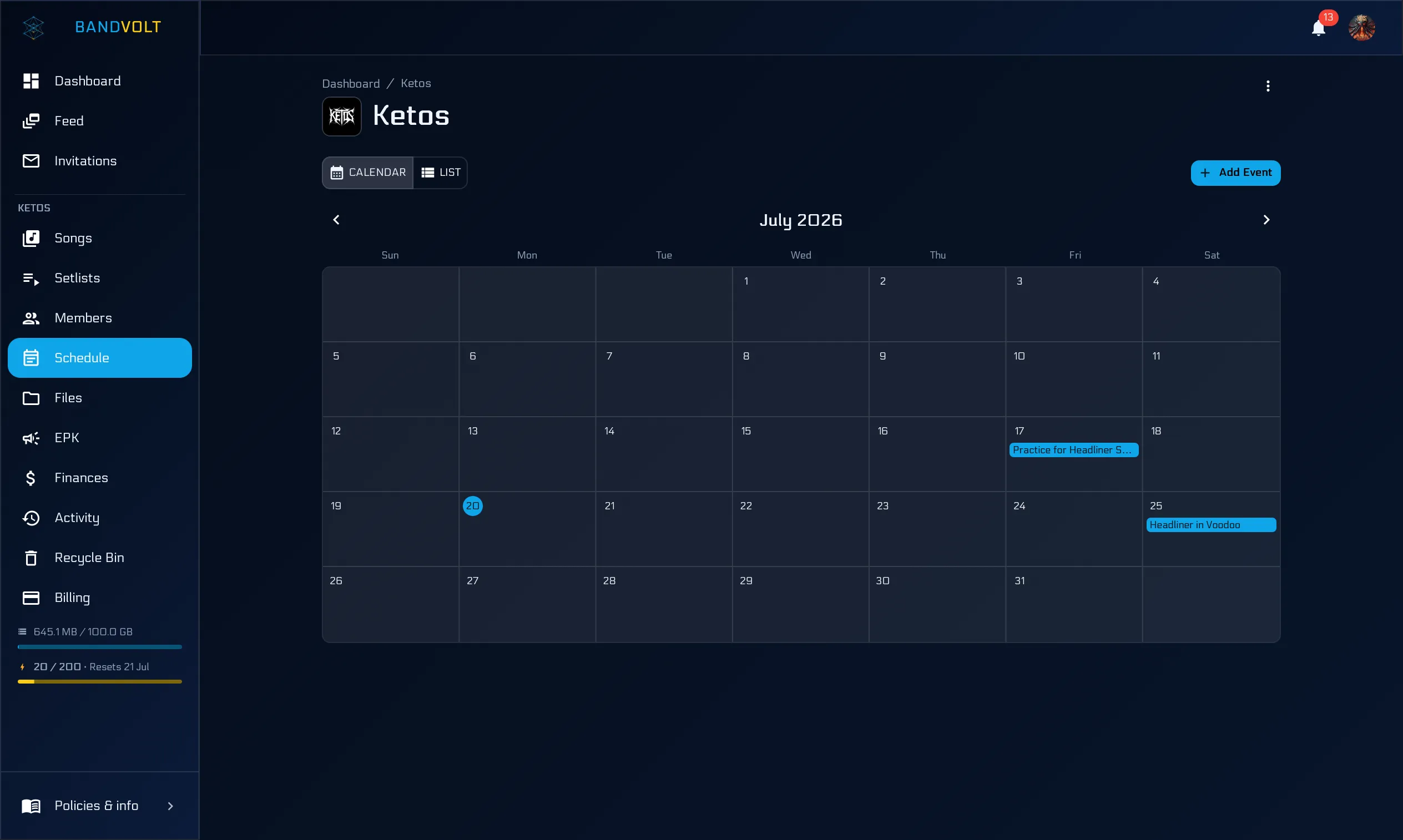
Tracking weekends, mix deadlines, release dates, and gigs all live on the same calendar. Setlists attach to events. Files attach to events. When the schedule changes, nobody has to retype it across three apps.
For a remote band the calendar is doing more work than it does for a local one. It is not just “when is rehearsal” - it is the shared sense of what is happening and when, which is the thing you lose when you are not in a room together every week. A song with a mix deadline on the calendar behaves completely differently from a song without one.
Bringing in people who are not in the band
Remote working almost always means working with people outside the lineup - a producer, a mix engineer, a session player, someone doing artwork.
The failure mode here is access sprawl: a Dropbox link for one person, an email attachment for another, a WeTransfer that expired for a third, and no idea afterwards who still has what.
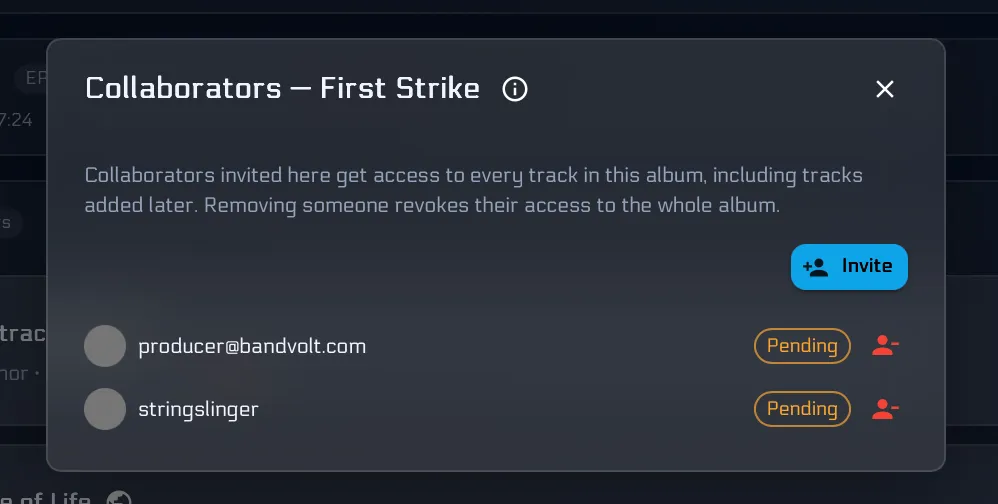
A cleaner approach is to invite collaborators to the specific song or collection they are working on, so they get the versions, stems, and comments for that work and nothing else - and you can revoke it when the job is done. We wrote more about that in working with session players without fourteen emails.
Keep the record of decisions
The last piece is the least glamorous and the one that saves the most time: write down what you decided, where the work is.
Not minutes. Just the outcome, attached to the thing it is about. “Going with the shorter bridge” as a resolved comment on the song beats the same sentence in a chat thread, because in six weeks nobody will scroll back through six weeks of chat, but they will open the song.
The same applies to the money and the admin. When the band is not in a room, the shared ledger is the only thing stopping “who paid for the mastering?” becoming a genuinely awkward conversation months later.
Less ceremony, more output
Remote bands do not need more meetings. They need fewer dead drops between meetings. A single workspace is the difference.
If you only change one thing this month, change the handoff sentence. Put a date and a name on every piece of work you put down. Everything else in this post is infrastructure for making that sentence easy to keep.
Frequently asked questions
How can a band work together remotely?
Put the music and the conversation about it in the same place, agree who is doing what next after every handoff, and give every task a date. Remote bands rarely fail because of distance - they fail because work sits in someone's inbox with no owner and no deadline, and nobody wants to be the one chasing it.
What is the biggest problem with remote bands?
Silence that looks like progress. In a rehearsal room you can see that nothing has happened for a month. Remotely, everyone assumes somebody else is working on it. The fix is making the current state of every song visible without anyone having to ask.
How often should a remote band meet?
Short and regular beats long and occasional. A 20-minute call every couple of weeks where you look at what has actually moved keeps a project alive far better than a three-hour session every quarter, because the gap between problems appearing and being noticed stays small.
Do you need a DAW to collaborate remotely?
Whoever is recording or mixing needs one. The rest of the band needs to hear versions, leave notes, and know what is happening - which is a different job. Keeping band collaboration separate from the DAW session means nobody is blocked on owning the same software or opening a project they cannot run.
Topics: remote band collaboration · long distance band · collaborative songwriting app