

WhatsApp vs timestamped mix feedback
Voice notes, "the bit after the second chorus", and mixes compressed on send - a side-by-side look at why a group chat fails as a mix review tool, and what timestamped comments do instead.
By @KHeavy · Updated 1 August 2026
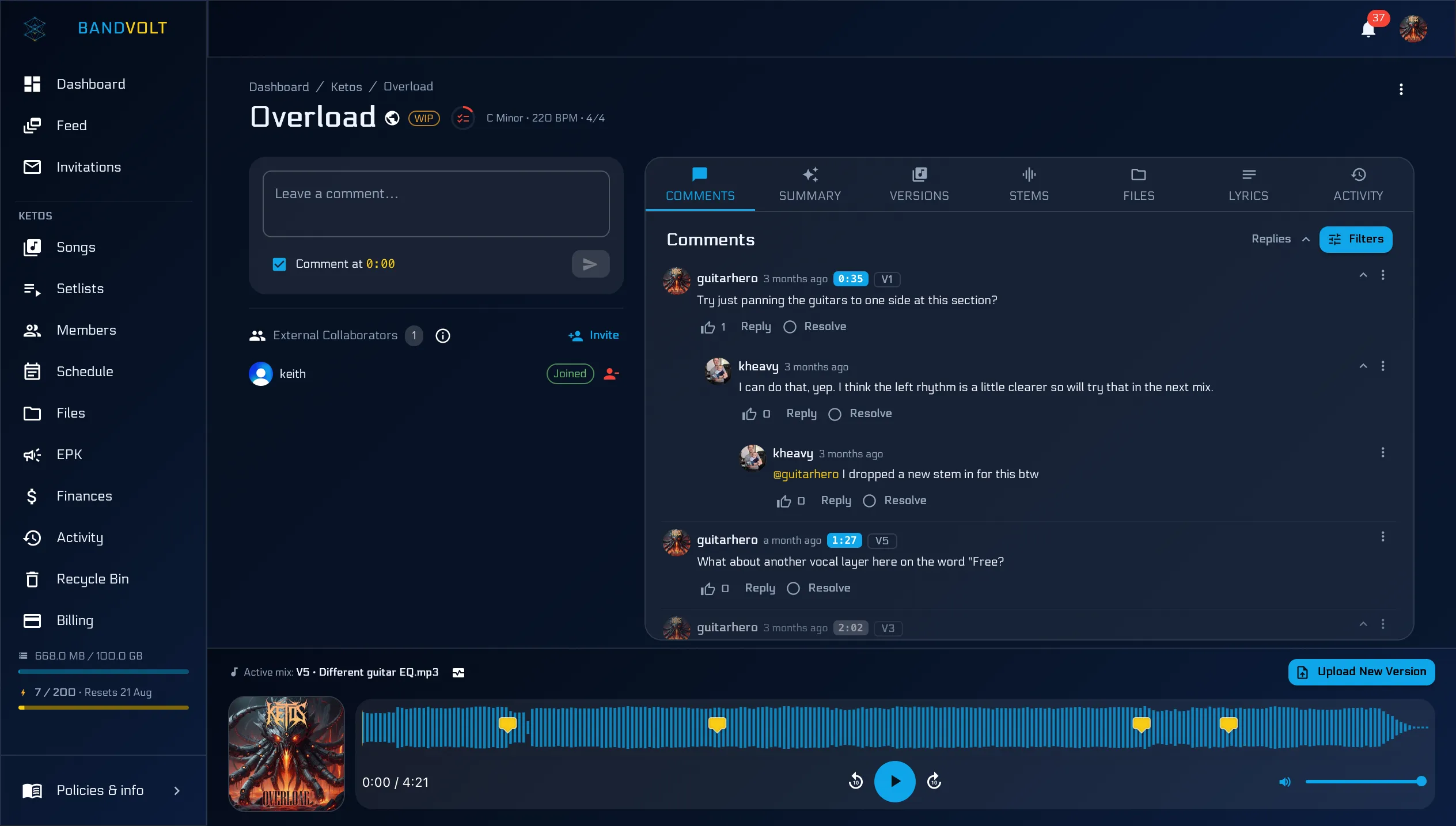
The short answer: WhatsApp is a great band chat and a terrible mix review tool. Audio sent as media is compressed, feedback scrolls away within days, and “the bit before the last chorus” pins nothing to nothing. Timestamped comments attach every note to the exact second of a full-quality track - which is how BandVolt handles feedback, free on the Basic tier.
Every band has done this. The new mix lands in the group chat. Three voice notes, a “sounds sick 🔥”, and one genuinely useful comment about the vocal level - which nobody can find two weeks later, because it is buried under forty messages about Saturday’s load-in time.
WhatsApp is where band logistics live, so it feels natural to review mixes there. Here is why it does not work.
The mix you’re reviewing isn’t the mix
Send an audio file through a chat app as ordinary media and it is typically compressed on the way - the band is passing judgement on a degraded copy of the mix. There is a workaround (attach it as a document instead), but now you are managing workarounds, and either way the file is a message in a chat, not a version of a song.
This produces a specific and maddening failure: the band gives notes on the top end being harsh, the engineer cannot hear what they mean, and everyone concludes they disagree about the mix. They do not. They are listening to different files.
BandVolt never compresses your audio. The file your band plays back is bit-for-bit the file that was uploaded - and it lands as a labelled, dated version in the song’s history, not as Anthem_mix4 (3).wav in someone’s downloads.
”The bit after the second chorus” is not an address
Chat feedback has no coordinates. “The guitars feel harsh in the bridge” makes the mix engineer scrub the track hunting for what you meant, and half the notes are voice memos they have to transcribe by ear.
A timestamped comment is pinned to the exact second it refers to. Click the pin, hear the moment, fix the thing. Replies thread under the note, the band can upvote what matters, and each comment gets marked resolved when actioned - so the open list is the to-do list.
Feedback that scrolls is feedback that’s lost
A chat has one timeline for everything: the mix notes, the rehearsal poll, the meme. Three days later the useful feedback is effectively gone, and someone asks the engineer “did you see my message about the hi-hats?” They did not.
On the song itself, feedback has nowhere to scroll away to. And when a track collects forty comments, BandVolt’s AI Mix Summary distils every unresolved note into a short list of what actually needs to change - so the engineer walks into the session with a punch list, not a chat scrollback.
Side by side
| The job | Group chat | Timestamped feedback |
|---|---|---|
| Audio quality the band judges | Compressed unless you remember the workaround | The exact file that was uploaded |
| Locating a note in the track | Described in words, hunted for by hand | Pinned to the second, one click to hear it |
| Knowing which mix a note is about | Whatever was posted most recently | Attached to that specific version |
| Finding a note next week | Scroll back through everything | Still on the track, still in place |
| Knowing what is outstanding | Somebody’s memory | Unresolved comments are the list |
| Forty notes at once | A wall of messages | Summarised into a punch list |
| Arranging lifts to the gig | Excellent | Not what it is for |
That last row is not a joke. Chat is genuinely the right tool for most of what a band does together. It is just the wrong shape for a discussion that moves back and forth across three and a half minutes of audio.
What to do about the voice notes
Voice notes deserve their own mention, because bands love them and mix engineers quietly dread them.
They are fast to give and slow to use. A ninety-second voice note containing three real observations has to be listened to in real time, transcribed by ear, and mapped onto moments in the track by someone guessing at what “just before the drums come back” means. It cannot be searched, cannot be grouped with the two other people who said the same thing, and cannot be ticked off.
If someone in your band thinks best out loud, that is fine - the fix is to land the conclusion as a timestamped comment afterwards, so the note exists in a form somebody can act on.
Keep the group chat
This is not an argument against WhatsApp. The chat is where the band lives - keep it for the banter and the load-in times. Just stop asking it to be a review desk: post the link, not the file, and keep the notes on the track.
In practice the change is one habit. When a new mix is ready, the message in the chat is a link and a deadline - “new mix up, notes by Sunday” - and the notes themselves happen somewhere they will still exist on Monday.
Put your next mix where feedback sticks - free on the Basic tier, no credit card required. More on how timestamped feedback works.
Frequently asked questions
Does WhatsApp reduce audio quality?
Audio sent as ordinary media in a chat app is typically compressed on the way through, so the band ends up judging a degraded copy rather than the mix. Sending it as a document instead usually preserves the file, but that is a workaround you have to remember every single time.
Why is a group chat bad for mix feedback?
Chat runs on one timeline for everything, so mix notes sit between load-in times and memes and are gone within days. It also has no way to point at a moment in a track, so every note has to describe its own location in words - and no way to say which version it was about.
Should our band stop using WhatsApp?
No. It is a good band chat and there is no reason to give it up. The change is narrower than that: post a link to the mix rather than the file, and keep the notes on the track where they stay attached to the second and the version they refer to.
What about voice notes as mix feedback?
They are fast to record and slow to use. Whoever is mixing has to listen in real time, transcribe by ear, and work out which moment each remark refers to - and voice notes cannot be searched, grouped, or marked as resolved. They are fine for enthusiasm and poor for instructions.
Topics: WhatsApp band feedback · mix feedback tool for bands · group chat alternative