

How to give feedback on a mix
A complete guide for bands - what to listen for, how to describe what you hear without production jargon, how many rounds a mix should take, and how to disagree without stalling the record.
By @KHeavy
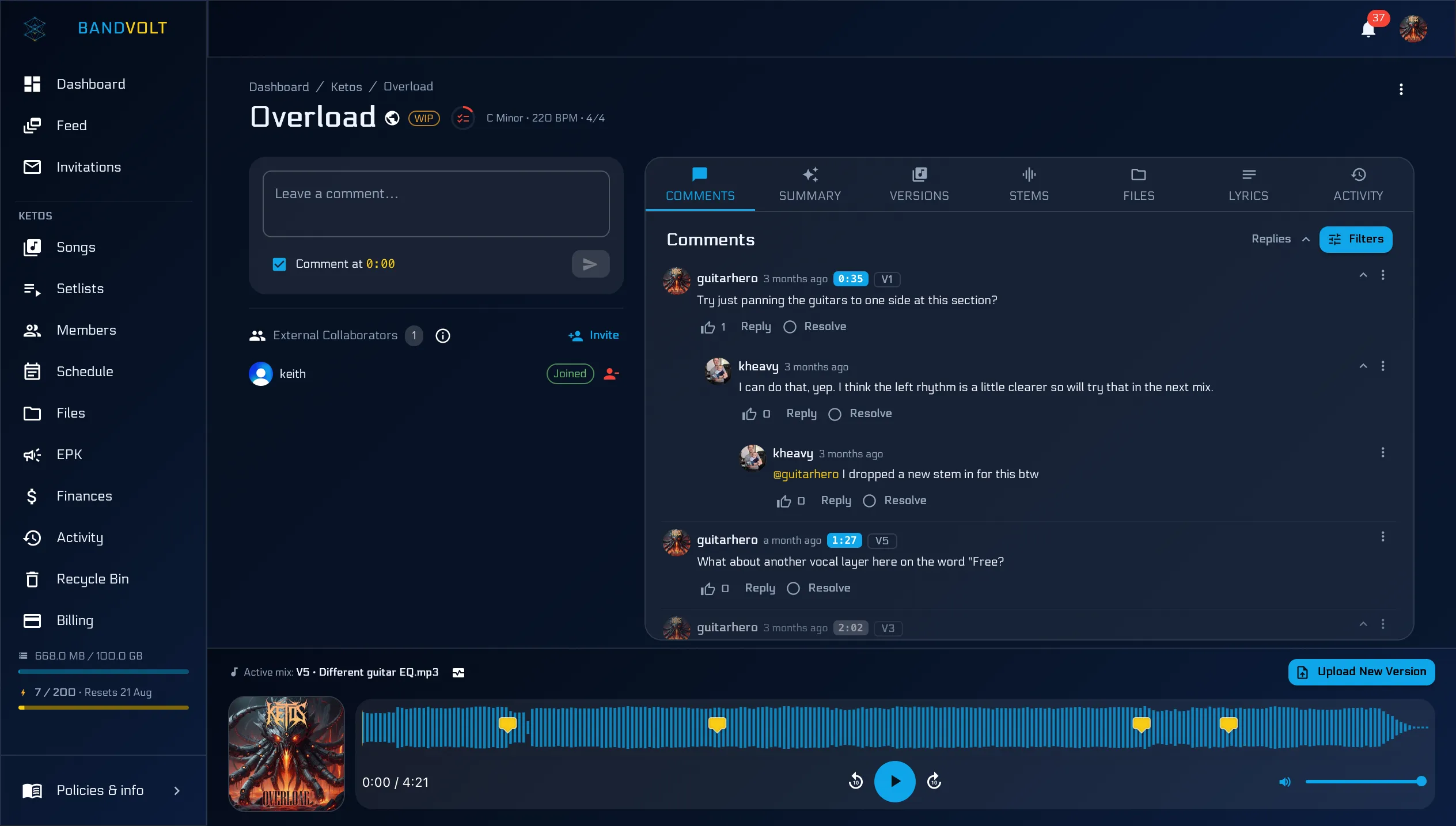
The short answer: listen right through once before commenting, then give each note three parts - where it is, what you hear, and what you would rather. Pin it to the timestamp so nobody has to guess, describe problems rather than prescribing settings, and expect two or three rounds, not ten.
Most bands have never been taught how to give mix feedback, which is odd given how much of a record’s fate depends on it. Vague notes cost bounces. Prescriptive notes tie the engineer’s hands. Notes that arrive in five different places cost more time than they save.
This is the version I wish someone had handed me before the first time a producer sent our band a mix.
Before you write anything: listen properly
Three rules that do more for feedback quality than anything else on this page.
Listen all the way through once without commenting. Your first pass is the only time you will ever hear the mix the way a stranger will. Take that seriously - notice what you feel, not what you would change. Then go back and be analytical.
Listen on something ordinary. Whatever monitoring you have, also play it on a phone speaker and in a car. Most of your listeners will hear something closer to that than to a good pair of headphones, and problems that only appear there - a bass line that vanishes, a vocal that gets buried - are real problems.
Listen when you are not tired. Ears fatigue quickly and fatigued ears want everything louder and brighter. Feedback given at midnight after a session is the most likely to be wrong and the most likely to be delivered forcefully.
The passes
Trying to hear everything at once produces “it feels a bit off”, which helps nobody. Do separate passes, each with one job:
- Lead vocal. Is every word intelligible? Does it stay present in the loud sections? Does it feel like it is in the room with the band or stuck on top of it?
- Low end. Kick and bass - can you tell them apart? Does the low end disappear on small speakers, or overwhelm on big ones?
- Drums and rhythm. Does the snare cut through when the guitars arrive? Is the kit sitting in the track or in front of it?
- Balance and arrangement. Is anything fighting? Are there sections where too much is happening for anything to land?
- Whole-track feel. Does the energy build where it should? Does the chorus arrive?
Write notes as you go, in the pass they belong to. Notes written afterwards from memory are, almost without exception, worse.
The anatomy of a note
Every useful note has three parts. Two of them people usually skip.
Where. Handled automatically if you pin the comment to the waveform instead of describing the location in words. “The bit before the last chorus” is a sentence the engineer has to decode; 2:41 is not.
What you hear. The observation, in plain language. “The vocal drops behind the rhythm guitars here.”
What you would rather. The direction, not the implementation. “I want to hear the words through this section.”
Put together:
2:41 - “The vocal drops behind the rhythm guitars and I lose the words. I want the lyric to stay clear through this section.”
That is a note anyone can act on, including someone who has never met your band.
Describe the problem, not the setting
The most common well-intentioned mistake is prescribing the fix. “Add some 2k to the vocal” sounds helpful and technical. It usually is not, for two reasons.
First, you might be wrong about the cause. The vocal may not need more 2kHz - the guitars may need less. An engineer told to boost the vocal will boost the vocal, and now two things are fighting harder.
Second, it removes the one thing you are paying them for. Whoever is mixing knows their tools; what they cannot know is what you hear and what you want. Give them that and they can pick the best fix, which is frequently not the one you would have suggested.
Say what is wrong. Let them work out why.
Words that are not as useful as they feel
- Muddy - could mean low mids, could mean too much reverb, could mean too many parts. Say what you cannot hear.
- Punchy - not a control. Try “the snare gets lost when everything comes in”.
- Bigger - louder? wider? more reverb? All three are different requests.
- Warmer - almost always means “less harsh up top” or “more low mids”, and it is worth saying which.
- It doesn’t sound like the demo - useful and worth pursuing, but say which part. Bands get attached to demo artefacts, and sometimes the thing you miss is a mistake worth keeping.
You do not need production vocabulary. You need to describe what you hear as precisely as you would describe a noise your car is making.
How many rounds is normal
Two or three. That is what a healthy mix conversation looks like: an initial mix, a round of notes, a revision, a smaller round of notes, a final.
If you are on round five or six, something other than the mix is wrong. Usually one of:
- The arrangement is the problem. No amount of mixing fixes a section that is too long or a part that should not be there. This is the most common one and the hardest to say out loud.
- The performance is the problem. Sometimes the take is the take, and mixing is being asked to rescue it.
- The band has not agreed what it wants. Two people pulling in opposite directions produces a mix that oscillates between two poles and satisfies nobody.
- Nobody wants to say it is finished. Perfectly normal, quietly fatal. At some point “done” is a decision, not a discovery.
Naming which of those it is will save you more time than another six bounces.
Comparing versions without fooling yourself
When a revision arrives, resist the urge to declare it better or worse from memory. Auditory memory for detail is short, and the louder version wins by default whether or not it is actually improved.
Switch between the two at the same point in the song, at matched levels, listening for one element at a time. That is what Quick Compare is for, and the method is covered properly in hearing what actually changed.
The most valuable outcome of a proper comparison is often the least exciting one: these are basically the same. That means the mix has stopped improving, and it is time to ship.
Feedback as a group
A few conventions that stop five people’s notes becoming noise.
Everyone comments in the same place. Split feedback across chat, email, and voice notes is how notes get missed, and the person who gets blamed is always the person mixing.
Duplicates are signal, not clutter. If four people independently say the vocal is buried, that is much stronger information than one person saying it four times. Let the duplicates stand - or upvote, so weight is visible.
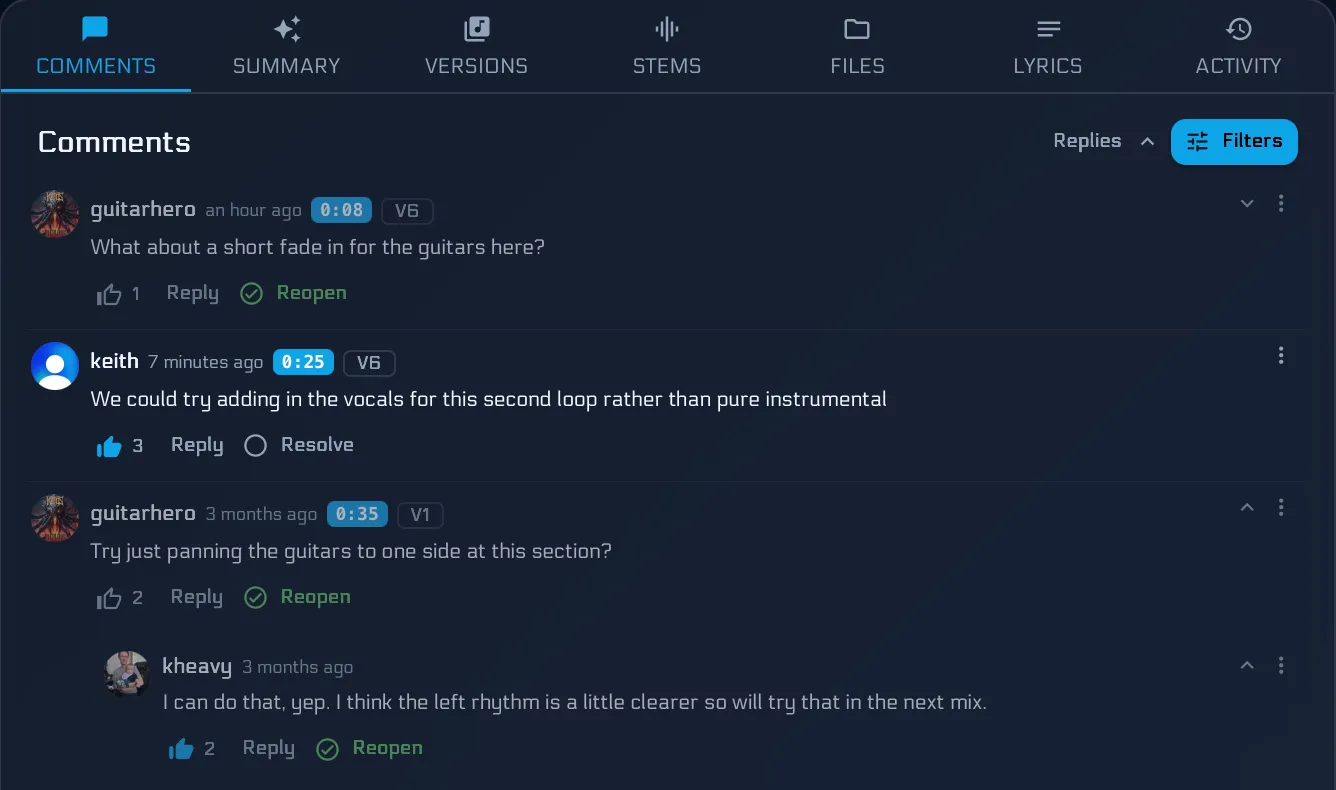
Resolve notes as they are actioned. The open list should be the to-do list. Without this, the thread just grows and everybody stops reading it.
When the thread gets long, summarise it. Past thirty or forty comments no producer can hold the whole picture. AI Mix Summary groups the overlapping notes into a prioritised punch list so the next session starts with a plan.
Agree who decides. Not every note can be actioned, and some contradict each other. Bands that have never decided who breaks a tie discover it at the worst possible moment.
Give the thing a deadline
The last piece is the least musical and the most effective: put a date on it.
“New mix up, notes by Sunday” changes the behaviour of the entire band. Without it, feedback trickles in over two weeks, the producer never knows if more is coming, and the song loses momentum for reasons unrelated to the music. State the deadline and state what silence means - in most bands, no notes by the deadline means you are happy.
The short version
- Listen once without commenting, then in passes.
- Where, what you hear, what you would rather.
- Describe problems; leave the fix to whoever is mixing.
- Pin every note to a timestamp and to a version.
- Expect two or three rounds. If you are on six, the problem is not the mix.
- Compare properly before you say the new one is worse.
- Put a deadline on it.
Put your next mix somewhere feedback sticks - free on the Basic tier.
Frequently asked questions
How do you give feedback on a mix?
Listen all the way through once without commenting, then go back and make each note say where it is, what you hear, and what you would rather. Pin the note to the timestamp so nobody has to hunt for the moment. Describe the problem in plain language and leave the solution to whoever is mixing.
What should you listen for in a mix?
Do separate passes rather than trying to hear everything at once. One for the lead vocal, one for the low end, one for the drums, one for the overall balance and arrangement, and one on a bad speaker - a phone or a car - because that is how most people will hear it.
How many rounds of mix revisions are normal?
Two or three is typical and healthy. Beyond about four the notes usually stop being about the mix and start being about the arrangement, the performance, or an unresolved disagreement in the band. That is worth naming, because more mix passes will not fix any of those.
Should I tell the mix engineer how to fix something?
Describe the problem, not the setting. "The vocal disappears when the guitars come in" gives an engineer everything they need and leaves them free to fix it the best way. "Add 3dB at 2kHz" prescribes a solution that may not be the right one, and makes it harder for them to do their job.
What if the band disagrees about a mix?
Get the disagreement stated properly, then decide who decides. Most mix arguments are actually about arrangement or about taste, and they do not resolve by trying more mixes. Agree in advance whose call it is on close ones - usually the person who wrote the song or the producer - and move on.
Topics: how to give feedback on a mix · mix notes · mix revision rounds · working with a producer